2.8L N/A 318hp Build Recipe

Naturally aspirated tech and talk
michaelmount123
Posts: 299
Joined: Fri Jul 09, 2021 7:51 am
Has thanked: 26 times
Been thanked: 179 times
I left the corporate world in 2002 to pursue a business building race engines and racing. I had been racing and building engines long before that, but not to support a lifestyle. I focused on the 944 since "everyone" was doing 911 flat 6's and I've always been partial to doing things a little differently. I'm happily retired now, and a bit disappointed there're not more engine builders focused on the 944. I'd like to pass on a little knowledge, perhaps an attempt to give back to the community for all the fun and success I've had related to the 944, and to help those 944 enthusiasts who want to step up their program. I can make this a continuing series with a focus on various projects, or just answer questions that are based on the projects I describe. Tom and the community will determine the path forward.

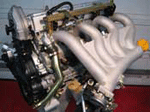
Here's an engine I built in 2005 for a client on the east coast. It's a 3L block with a 2.5L crank, built to do track days and some light racing. It made great power, and has been in service for 18 years, so it's longevity is established.

Block: S2 sleeved in my shop with a 4.155" bore. Darton flanged sleeves.
Crank: 2.5L with lightened counterweights, and cross-drilled #2 and #3 rod journals.
Displacement: 2.8L or so.
Connecting rods: Pauter standard 944 rods. 5.908" center to center.
Pistons: JE custom with a -11cc dish and standard size 24mm wrist pins.
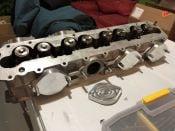
Cylinder head: 944S2 with 968 39mm intake valves and standard 33mm exhaust valves. Ported in house. 40cc chamber.
Used a .040 Cometic head gasket for 13:1 compression ratio.
Sunoco 'Blue' fuel, 108 octane.
Intake: Billet intake manifold for Weber DC0 50mm carburetors.
Rings: Total Seal .043/.043/3mm with Gapless top ring. (This is old school!) 10# pull on oil ring.
Camshaft: Elgin Race Cams 290/280 Hydraulic profile with 111 degree centerline spec, but measured 107 degree C/L.
Valve springs: S2 springs set up to accommodate .445" intake lift and .435" exhaust lift.
Ignition: Electromotive HPV-1 (unfortunately NLA)
Wet sump - Porsche 944 oil pan and standard 944 oil pump
As always, attention to detail in all aspects of the engine build was adhered to. The results on our engine dyno speak for themselves:

Max power 317 @ 7500rpm
Max torque 237 @ 6400
DC075379-9451-4276-B8CC-DAD0F5067340.jpeg
DC075379-9451-4276-B8CC-DAD0F5067340.jpeg (1.74 MiB) Viewed 3786 times

#1

User avatar
Tom
Site Admin
Posts: 8912
Joined: Fri Jun 25, 2021 2:04 pm
Location: Silicon Valley, CA
Has thanked: 931 times
Been thanked: 3988 times
Contact:
Wow, super cool to see this. Thank you!!! I'd personally love to see this be a continuing series -- anything I can do to be supportive of that just say the word! I have a few ideas about how to feature your input, but don't want to get ahead of myself. :) As you know, I've been hoping Carpokes can help the world get to know you and your work a little better, so love seeing this. There just aren't many like you around, and even fewer (if any) willing to share so generously like this.
At the risk of focusing on one tiny aspect of your build, curious why you only drilled 2 and 3 on the crank? Just not worried about 1 and 4? Also, I used to use "Armando" for crankshafts, but he moved away and have had no luck reaching him. I've been unable to find anyone I trust to cross-drill a crank -- so I had a good 88mm crank polished and was planning to just use it that way in my upcoming 3L turbo motor (street car). Is there someone out there who is accessible you'd trust to do a crank these days?

#2

User avatar
four0four
Posts: 184
Joined: Wed Feb 02, 2022 10:09 pm
Location: Western WA
Has thanked: 22 times
Been thanked: 32 times
I can make this a continuing series with a focus on various projects
this would rock, I think! ...I also wonder if you might find a podcast (thinking here of hp academy, but I'm sure there's others) to chat with if that's remotely your speed...

I'm also gonna pick a tiny detail to ask about - I'm surprised this stayed wet sump! Is the dip in oil pressure after ~6400rpm cavitation in the georotor, or something else?

#3

User avatar
Tom
Site Admin
Posts: 8912
Joined: Fri Jun 25, 2021 2:04 pm
Location: Silicon Valley, CA
Has thanked: 931 times
Been thanked: 3988 times
Contact:
four0four wrote: Fri Apr 28, 2023 7:23 pm
I can make this a continuing series with a focus on various projects
this would rock, I think! ...I also wonder if you might find a podcast (thinking here of hp academy, but I'm sure there's others) to chat with if that's remotely your speed...

I'm also gonna pick a tiny detail to ask about - I'm surprised this stayed wet sump! Is the dip in oil pressure after ~6400rpm cavitation in the georotor, or something else?
We could certainly host podcast style interviews here on Carpokes if interested. :)

#4

michaelmount123
Posts: 299
Joined: Fri Jul 09, 2021 7:51 am
Has thanked: 26 times
Been thanked: 179 times
I'll address the questions that have come up so far:

I always cross-drilled the #2 and #3 crankshaft rod journals since these are the ones that I've seen fail. Is the cross-drilling necessary? Certainly debatable, but it seems to help. The bigger/better path forward is the rod bearing selection available today. The soft Glyco bearings that are "standard replacement" do not hold up well in a performance environment. ACL Race Bearings for the 944 (PN 4B2475H) are designed for a race application and should now be used on any performance 944.

The oil pressure "drop" shown on the dyno is insignificant. It shows falling pressure, but not enough to cause worry. The pressure drop is likely a result of the oil temperature; as it climbed, the pressure dropped slightly. The gerotor pump is quite efficient and although cavitation can occur, I'm not buying that it's an issue with our 944 oil pumps. More detrimental are the G-forces acting on the oil level in the pan as it tries (and sometimes succeeds) to get away from the oil pickup.

#5

User avatar
gruhsy
Posts: 517
Joined: Mon Jul 05, 2021 10:02 am
Has thanked: 48 times
Been thanked: 81 times
Was this the Yellow 944 car?

#6

User avatar
Tom
Site Admin
Posts: 8912
Joined: Fri Jun 25, 2021 2:04 pm
Location: Silicon Valley, CA
Has thanked: 931 times
Been thanked: 3988 times
Contact:
michaelmount123 wrote: Sat Apr 29, 2023 11:01 am I'll address the questions that have come up so far:

I always cross-drilled the #2 and #3 crankshaft rod journals since these are the ones that I've seen fail. Is the cross-drilling necessary? Certainly debatable, but it seems to help. The bigger/better path forward is the rod bearing selection available today. The soft Glyco bearings that are "standard replacement" do not hold up well in a performance environment. ACL Race Bearings for the 944 (PN 4B2475H) are designed for a race application and should now be used on any performance 944.

The oil pressure "drop" shown on the dyno is insignificant. It shows falling pressure, but not enough to cause worry. The pressure drop is likely a result of the oil temperature; as it climbed, the pressure dropped slightly. The gerotor pump is quite efficient and although cavitation can occur, I'm not buying that it's an issue with our 944 oil pumps. More detrimental are the G-forces acting on the oil level in the pan as it tries (and sometimes succeeds) to get away from the oil pickup.
Curious if you are a believer in the Accusump for the 944?

#7

michaelmount123
Posts: 299
Joined: Fri Jul 09, 2021 7:51 am
Has thanked: 26 times
Been thanked: 179 times
Hmmm. Accusump. I don't believe the system can save the engine when the oil pick-up gulps air. Once it realizes the oil pressure differential, the engine damage is done. The benefit of the Accusump, I believe, is on start-up. Pre-oiling before start-up is a great thing, but as an engine "saver" for loss of OP, not so much. I think it's just carrying around extra weight.

#8

User avatar
Cruise98
Posts: 108
Joined: Tue Jan 04, 2022 4:55 pm
Has thanked: 16 times
Been thanked: 23 times
I am curious about the details on the Darton flanged sleeves. I just had a block sleeved, and it was a failure. We had a "D" chunk come out of cylinder 1, and there were small cracks at the crank web to cylinder interface. The flange was only supported at the top since the cylinder was bored all the way to the crank web.

#9

michaelmount123
Posts: 299
Joined: Fri Jul 09, 2021 7:51 am
Has thanked: 26 times
Been thanked: 179 times
Cruise98 wrote: Wed May 03, 2023 8:50 am I am curious about the details on the Darton flanged sleeves. I just had a block sleeved, and it was a failure. We had a "D" chunk come out of cylinder 1, and there were small cracks at the crank web to cylinder interface. The flange was only supported at the top since the cylinder was bored all the way to the crank web.
So sorry about your failure. How much press did the sleeve have? I hear about way to many failures with sleeving these blocks. It's really not rocket science, just attention to detail.
- It's fine to bore all the way down a cylinder if you're using flanged sleeves. The flange locates and secures the sleeve at the top of the block, rather than the bottom. Works fine.
- Press on the sleeve is .001-.002" / .025-.050mm.
- Make sure the sleeve is pressed all the way down to the machined step. When the block is heated (in a hot spray washer, for example), the sleeve will pop up as the block cools. The last process in sleeving is usually to resurface the deck, and if the sleeve has popped up it will drop when the head is torqued - no more head seal.
- If there's interest, I can provide a PN for the Darton sleeves that I use for the 944.

#10

Post Reply