5. Fuel Pressure and Injector Size Adjustments
The stock 944 Turbo chips are mapped for use with the stock 384cc/min injectors and stock 2.5 Bar fuel pressure regulator. To change that for different fuel pressures or injectors, you can adjust the fuel quality switch (FQS) settings in TunerPro. The FQS is a rotary switch on the DME with 8 positions (0 to 7), which can be used to make global scaling adjustments to the fuel flow, as well as ignition timing adjustments. The factory included it as a way to accommodate different levels of fuel quality around the world, but we can repurpose those settings to account for bigger injectors and more fuel pressure. In TunerPro, you'll need to adjust the flow rate for the particular FQS switch position you plan to use.
- FQS MAP.jpg (56.88 KiB) Viewed 3936 times
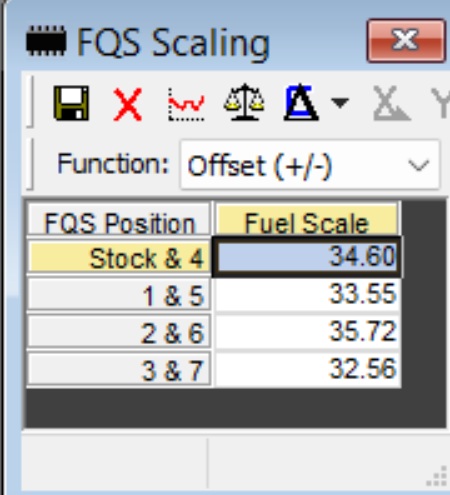
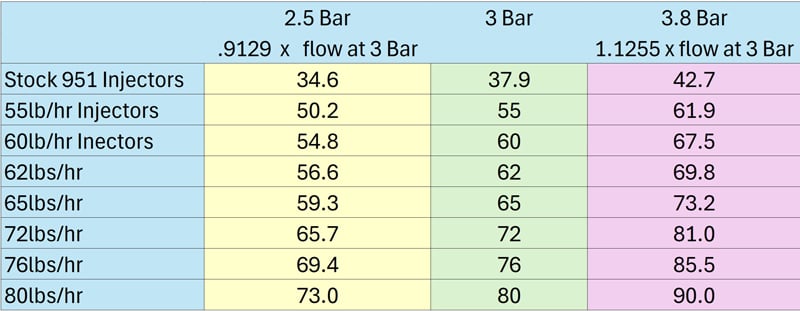
In our XDF file for TunerPro, the FQS numbers are entered as injector flow rates in lbs./hr. In the table above, it shows the flow set at 34.6 pounds per hour for FQS positions number 0 and 4 -- i.e., the flow rate of the stock injectors at 2.5 Bar fuel pressure. If you were running 62 lbs./hr. injectors at their rated pressure of 3 Bar, for example, you can simply enter 62 in the desired FQS position and all the fuel maps will be scaled accordingly. (But see injector dead-time adjustments below.) Flow ratings for nearly all injectors are based on 3 Bar of fuel pressure. If you keep the factory 2.5 Bar fuel pressure regulator, or run anything other than 3 Bar of pressure, you will need to adjust the FQS flow rate to account for the change in pressure. The math for doing that is summarized below, but to make things easier, here is a chart showing the numbers to enter into the TunerPro’s FQS cells for various injector flow rates and fuel pressures. It shows 2.5, 3, and 3.8 Bar because those are the common fuel pressure regulators that fit the 944 turbo.
- FQS-Final-Chart.jpg (137.49 KiB) Viewed 3533 times
The Math: If you want to do your own math, you'll need to know what your injectors are actually flowing in lbs./hr. at whatever pressure you are running, and enter that in the FQS cells. As an example, the stock injectors are rated to flow 384cc/minute at 3 Bar of fuel pressure, which translates to about 37.9 pounds of fuel per hour (assuming a typical gallon of E10 gas weighs about 6.2 pounds). However, the stock 944 Turbo has a 2.5 Bar fuel pressure regulator, so the injectors will flow less than that.
How much less? The change in flow is proportional to the square root of the quotient of the new pressure (2.5 bar) divided by the original pressure (3 Bar). Doing that math: 2.5/3 = .833... and the square root of that is ~.9129. So if the injectors flow 37.9lbs./hr. at 3 Bar, they will flow 37.9lbs./hr. x .9129 at 2.5 Bar, i.e., 34.6. Not surprisingly, that’s the number you’ll see in TunerPro when looking at FQS position 0 on a stock chip. If you were running an adjustable fuel pressure regulator at 3.4 Bar, for example, you’d get ~40.3lbs./hr. using the same math. The square root of 3.4/3.0 is 1.0646, so the stock injectors flow 1.0646 x 37.9lb/hr or 40.3lbs./hr. at 3.4 Bar. Note that this is also what you’d get by interpolating between the entries in the chart above.
Injector Flow Minutia:
You might be wondering why I say the stock injectors flow 37.9lbs./hr. at 3 Bar when most online sources say the 944 Turbo injectors flow 36 to 37lbs./hr. That's due to the way flow ratings are converted into pounds per hour. The injectors are rated at 384cc/min at 3 Bar, and there is no official rating in pounds per hour. To come up with a pounds per hour rating, you need to convert a volume of gasoline (cc’s) into a weight of gasoline (pounds). To do that, you need to make an assumption about how much gasoline weighs. The going rule of thumb is to divide cc/min by 10.5 to get lbs./hr. For the 944 Turbo injector, that means you would divide 384 by 10.5 to get about 36.6 lbs./hr., which is consistent with many online estimates. However, the 10.5 rule of thumb assumes gasoline weighs 6 pounds per gallon, whereas E10 gasoline in the US is closer to 6.2 pounds per gallon. At 6.2 pounds per gallon (6.22 to be exact), 384cc/min converts to 37.9lbs./hr. The reality is gasoline will vary in weight based on its formulation and ambient temps, so there is a false precision in this math, but using 6.22 pounds per gallon yields a more accurate conversion for typical US gasoline.
XDF and BIN Numbers Minutia:
The XDF is set up so that the numbers are easy for humans to understand. It then does math behind the scenes to populate the actual BIN files with numbers the DME can use. The DME works on a proportional increase or decrease from the number 128 – i.e., the mid-point of a single memory location’s range of 0 to 255, thereby giving it the same range whether adjusting up or down. That number is used to determine how long to open the injectors, so if the injectors flow more, the injectors don’t need to open as long and the number in the BIN needs to go down. As an example, if you have 62 pound injectors and a 3 Bar fuel pressure regulator and enter 62 for positions 0 and 4 in the FQS, you would see hex 47 (decimal 71) in the BIN. This is because the bigger injectors need to stay on about 55.8% (34.6 /62) as long at 3 Bar to flow the same as a stock 944 Turbo (128 x .558 = ~71).
Final Thoughts:
In practice, scaling the fuel using the FQS works quite well with most injectors, though it’s possible some injectors may not scale in a linear fashion across their entire flow range. For example, an injector that flows twice as much as a stock injector at 100% duty cycle may not flow exactly twice as much at a 50% duty cycle. Just something to keep in mind as you tune. And, various injectors will have different ‘dead-times’ such that the flow at idle and very low loads can be wrong despite perfect FQS scaling. For that, be sure to see the “Injector Dead Time Latency Adjustments” below. Don’t be tempted to ignore the dead-time and tune around it in the regular fuel maps. You’ll end up chasing the tune endlessly, like a dog after its own tail.