Page 3 of 8
Re: Broken A/C troubleshooting
Posted: Mon Jun 16, 2025 9:53 am
by Tom
Poorsche44 wrote: Mon Jun 16, 2025 8:45 am
No, there is no cooling effect at all even after driving for a bit. If the o rings are a necessary part of the 134 conversion, would it be redundant to pull a vacuum with the old ones still installed?
Changing all the o-rings to the green r134a-compatible versions is a good idea, and most are fairly easy to change -- at the compressor, receiver drier, condenser, etc. -- see below. I've changed all those as a natural step in changing those parts over the years. I never changed the ones at the firewall, and it hasn't been a problem. The system still stays charged from summer to summer, with an occasional top-off every few years. In theory, you would never need to top off, but I don't live in theory.

My thought on pulling the vacuum first was just to confirm that nothing major (e.g., condenser, evaporator, compressor, etc.) was cracked or broken -- if learning that early might dissuade you from going forward with the conversion/repair.
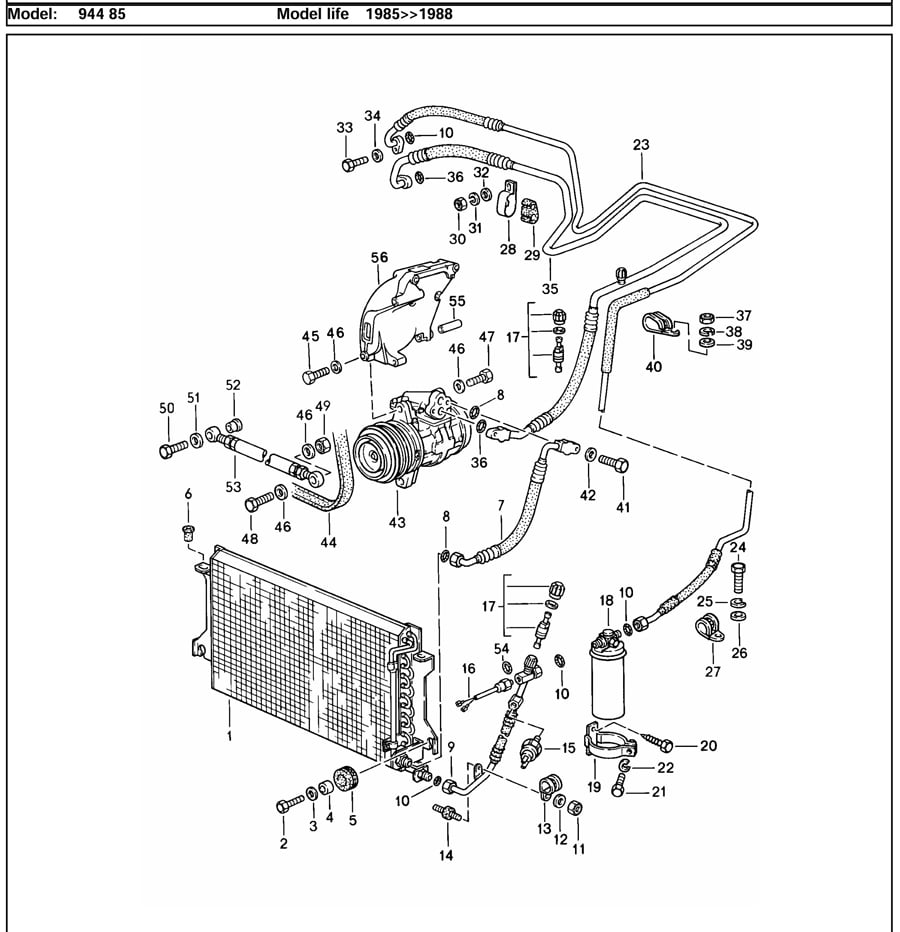
- ac-seals900.jpg (200.38 KiB) Viewed 389 times
Re: Broken A/C troubleshooting
Posted: Mon Jun 16, 2025 8:24 pm
by dr bob
Missed compressor manifold plate o-rings got me when I first did the R-134a conversion/upgrade on my 928. Like Tom, I still 'top off' a bit every few years. I have a bit of, um, seepage*** at the compressor shaft seal, sez the electronic sniffer. Lasts a -lot- longer if I drive and use the A/C more regularly, and keep that mechanical seal lubricated in the process. Otherwise the new hoses and green o-rings are still keeping things cool and contained more than 25 years after the original 'conversion'.
*** Seepage is a condition you monitor rather than actually solve. ref: 1960's E-type maintenance manual. Same description in my Norton Commando manual for he same period. If you chased down and actually solved every little seepage, you'd never get to actually drive a period British car or scooter. Ever. No A/C on the '67 E-type DHC back in the day, thank goodness! Plenty of seepages from the factory even before adding refrigerant systems to the inevitable-sources list.
Contrast: Last summer I added two (!!!) cans of R134a to K's 20 year old 4Runner. Almost identical Denso compressor. Almost. I often wonder if Porsche bought the leftovers for my car.
Re: Broken A/C troubleshooting
Posted: Thu Jun 19, 2025 6:35 am
by BennSport
As I’m going purchasing parts for the conversion, is there a specific 90 degree low side fitting that won’t interfere with the compressor bracket? It’s an early model and I want to make sure I order parts that fit the first time.
Re: Broken A/C troubleshooting
Posted: Thu Jun 19, 2025 7:04 am
by Gaspowered
I believe this should work.
https://a.co/d/aIx0yCL
I also meant to mention earlier that you might be able to "rent" gauges and a vacuum pump from your local auto parts store. (O'Reilly's, Auto zone, Advanced Auto, etc. You put a deposit down and then you get it back when you return the equipment.)
Cheers
Re: Broken A/C troubleshooting
Posted: Thu Jun 19, 2025 7:10 am
by BennSport
Perfect, thank you! Yea I was planning on renting the gauges and pump. However the gauges I found from autozone are only r134 compatible so I won’t be able to vacuum test before the conversion unfortunately. Would it be wise to also purchase some UV dye for future leak detection?
Re: Broken A/C troubleshooting
Posted: Thu Jun 19, 2025 7:36 am
by Tom
Poorsche44 wrote: Thu Jun 19, 2025 7:10 am
Perfect, thank you! Yea I was planning on renting the gauges and pump. However the gauges I found from autozone are only r134 compatible so I won’t be able to vacuum test before the conversion unfortunately. Would it be wise to also purchase some UV dye for future leak detection?
You can just put one or both adapters on and pull a vacuum to test. If you decide to not convert at that point, you can just remove the adapters. I'm lucky with my car because both ports are up by the strut tower. On the early 944, in addition to a 90 degree fitting, some people get a slightly smaller diameter belt, which apparently allows the belt to clear the adapter.
No personal experience with it, but on other boards people have said this belt works:
https://www.oreillyauto.com/detail/c/mi ... yota-camry
Re: Broken A/C troubleshooting
Posted: Thu Jun 19, 2025 8:25 am
by BennSport
Ah I see, do you happen to know if a shorter belt is a requirement for the 90 degree port to fit?
Re: Broken A/C troubleshooting
Posted: Thu Jun 19, 2025 9:53 am
by Tom
Poorsche44 wrote: Thu Jun 19, 2025 8:25 am
Ah I see, do you happen to know if a shorter belt is a requirement for the 90 degree port to fit?
I'm no expert on the early cars so hopefully someone will chip in on that, maybe
@gb951 ? I know others have said they needed a shorter belt, but I can't personally vouch for that. It may depend on the specific fitting you use, and how you position it. Napa sells one that looks pretty compact...
https://www.napaonline.com/en/p/TEM8014 ... 0947735025
Re: Broken A/C troubleshooting
Posted: Thu Jun 19, 2025 10:58 am
by gb951
Tom wrote: Thu Jun 19, 2025 9:53 am
Poorsche44 wrote: Thu Jun 19, 2025 8:25 am
Ah I see, do you happen to know if a shorter belt is a requirement for the 90 degree port to fit?
I'm no expert on the early cars so hopefully someone will chip in on that, maybe @gb951 ? I know others have said they needed a shorter belt, but I can't personally vouch for that. It may depend on the specific fitting you use, and how you position it. Napa sells one that looks pretty compact...
https://www.napaonline.com/en/p/TEM8014 ... 0947735025
I have filled my early 944 AC using a 90 degree adapter. I did not use a shorter belt, but I did notice that the belt was pretty loose during the process. Once the refrigerant was installed, I removed the adapter and adjusted the belt and all was good.
Re: Broken A/C troubleshooting
Posted: Thu Jun 19, 2025 12:36 pm
by BennSport
The 90 degree adapter I bought requires me to remove the valve core so I won’t be able to remove the adapter after. Oh well! I’ll play it by ear and see what happens. My last two questions are ab some additives. Is it a good idea to add some UV dye to the system to make it easier on finding leaks in the future? Or will that be bad for the health of the system? The same goes for my 100 W ester oil. Is it bad if there are any additives in it or does that not really matter?