


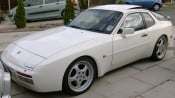
- 944 2.jpg (2.93 MiB) Viewed 21 times
Passenger side dip beam out.
-
dr bob
- Moderator
- Posts: 629
- Joined: Thu Jul 08, 2021 9:30 pm
- Location: Central Oregon
- Has thanked: 255 times
- Been thanked: 250 times
The DIN wiring insulation colors for the headlights have High (Main) Beam power on WS (white), Low (Dipped) Beam power on GE (yellow), and all chassis ground connections are BR (Brown).
With the headlights on and low/dipped beam, you should see battery voltage at the YELLOW wire contact in the socket, referenced to chassis ground.
Assuming you are using a conventional (Not LED) headlight bulb, you can use your Ohm meter to check for filament continuity between the bulb contacts that correspond to the YELLOW and BROWN wires. The reading should be in the <6 Ohms range if the filament is intact, and show infinite if the filament has failed/burned out.
I don't have the 944/951 wiring diagrams handy, so don't know the specific fuse arrangements. My car (1989 928) has individual fuses for each bulb filament, so a separate fuse dedicated to the right dipped beam filament. If yours has similar, of course you'll want to be sure you are inspecting the correct fuse. Bottom line for me anyway is that I can't rely on the opposite headlight working on low/dipped beam as an indicator that the fuse for the right side is intact.
If the main (high) beam element is working, it's likely the brown ground connection to chassis is intact.
-----
All that said, most "bulb doesn't work" conditions are caused by simple filament burn-out. Fuses are installed to protect wiring from overload and melted insulation, so i don't expect that protection to kick in unless there's a wiring fault to ground. The cars use relays to manage the various lighting functions, and one can pretty safely assume that if the opposite-side low-beam works, the headlight relay is also functioning.
For me, bulbs get replaced in pairs. Knowing the tiny bit I do about mass-product manufacturing and consistency, I figure that when one bulb decides to fail in normal use, the other similar bulbs are not far behind. And because brightness and color and lens condition vary with time and duty, I want the two bulbs to look and illuminate the same. I used to save the remaining-good bulb as a spare, but have revised that policy to just keeping new bulbs as spare, at least for the various markers and rear signal bulbs. The factory US headlight bulb size makes carrying them in the car as ride-along spares a bit of a chore.
Hope this helps!
With the headlights on and low/dipped beam, you should see battery voltage at the YELLOW wire contact in the socket, referenced to chassis ground.
Assuming you are using a conventional (Not LED) headlight bulb, you can use your Ohm meter to check for filament continuity between the bulb contacts that correspond to the YELLOW and BROWN wires. The reading should be in the <6 Ohms range if the filament is intact, and show infinite if the filament has failed/burned out.
I don't have the 944/951 wiring diagrams handy, so don't know the specific fuse arrangements. My car (1989 928) has individual fuses for each bulb filament, so a separate fuse dedicated to the right dipped beam filament. If yours has similar, of course you'll want to be sure you are inspecting the correct fuse. Bottom line for me anyway is that I can't rely on the opposite headlight working on low/dipped beam as an indicator that the fuse for the right side is intact.
If the main (high) beam element is working, it's likely the brown ground connection to chassis is intact.
-----
All that said, most "bulb doesn't work" conditions are caused by simple filament burn-out. Fuses are installed to protect wiring from overload and melted insulation, so i don't expect that protection to kick in unless there's a wiring fault to ground. The cars use relays to manage the various lighting functions, and one can pretty safely assume that if the opposite-side low-beam works, the headlight relay is also functioning.
For me, bulbs get replaced in pairs. Knowing the tiny bit I do about mass-product manufacturing and consistency, I figure that when one bulb decides to fail in normal use, the other similar bulbs are not far behind. And because brightness and color and lens condition vary with time and duty, I want the two bulbs to look and illuminate the same. I used to save the remaining-good bulb as a spare, but have revised that policy to just keeping new bulbs as spare, at least for the various markers and rear signal bulbs. The factory US headlight bulb size makes carrying them in the car as ride-along spares a bit of a chore.
Hope this helps!
dr bob
1989 928 S4, black with cashmere/black inside
SoCal 928 Group Cofounder
928 Owner's Club Charter Member
Former Ex Bend Yacht Club Commodore Emeritus
Free Advice and Commentary. Use At Your Own Risk!
1989 928 S4, black with cashmere/black inside
SoCal 928 Group Cofounder
928 Owner's Club Charter Member
Former Ex Bend Yacht Club Commodore Emeritus
Free Advice and Commentary. Use At Your Own Risk!
-
chrischrischris
- Posts: 132
- Joined: Mon Mar 03, 2025 11:10 am
- Has thanked: 4 times
- Been thanked: 34 times
You want Volts DC (not AC since that's what you would use in your house).