



Fuel coming out of cap on track
I'm having a bit of an issue when turning left where I get residue on the quarter panel after left hand corners on track. One of the other members of the club I'm in pointed it out, and has the same issue on his own car. Has anyone else run into this, or does anyone have a solution that isn't a fuel cell?
-
Tom
- Site Admin
- Posts: 8963
- Joined: Fri Jun 25, 2021 2:04 pm
- Location: Silicon Valley, CA
- Has thanked: 940 times
- Been thanked: 4026 times
- Contact:
Have you checked the rubber seal in the cap? They test the cap as part of CA smog testing, so I kept a close eye on mine and eventually replaced it with a generic cap from the auto parts store. I'd give yours a close look and maybe try a new one. Worth a try anyway. If the caps seals ok and it still leaks, then maybe it's one of the couplers or tubes on the mail fill tube?
-
walfreyydo

- Posts: 138
- Joined: Wed Dec 11, 2024 7:28 am
- Location: Wisconsin
- Has thanked: 28 times
- Been thanked: 58 times
- Contact:
I chased this issue for about 3 seasons. I also suspected the cap seal but after a number of replacements of the seal, the cap and then doubling up the seal, I discovered the issue wasn't the cap or the seal, but the fuel filler neck itself.
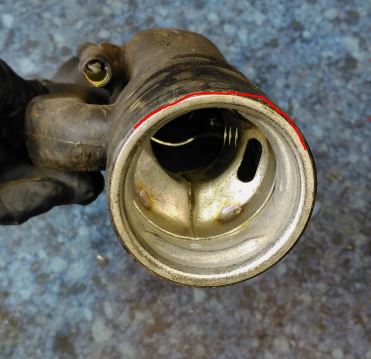
On the later cars, the filler neck is plastic with an inner metal sleeve and lip that the cap seals to. In my case, that sleeve had come unbonded from the plastic neck allowing fuel to spill out from around the metal sleeve and thereby bypass the cap and seal entirely.
This took a long time to figure out but the evidence was revealed when I removed the neck, secured the cap, and then filled the neck with water and held it upside down. Water then began to drip out quite clearly from the seal between the plastic neck and the metal sleeve (shown in red).
The fix for me was to replace with an early model filler neck which is a one-piece unit made of metal, which also required replacing the lower accordion sleeve, that connects the filler neck to the tank, with the corresponding piece from an early car. The rest of the hoses should reconnect to the filler neck as-is. If you didnt want to go this route you could opt for a new late model filler neck instead, or roll the dice on a used one which may eventually result in the same issue.
So, if you have a later car, this may be something to look into. If you have an early car, then this would not apply.
On the later cars, the filler neck is plastic with an inner metal sleeve and lip that the cap seals to. In my case, that sleeve had come unbonded from the plastic neck allowing fuel to spill out from around the metal sleeve and thereby bypass the cap and seal entirely.
This took a long time to figure out but the evidence was revealed when I removed the neck, secured the cap, and then filled the neck with water and held it upside down. Water then began to drip out quite clearly from the seal between the plastic neck and the metal sleeve (shown in red).
The fix for me was to replace with an early model filler neck which is a one-piece unit made of metal, which also required replacing the lower accordion sleeve, that connects the filler neck to the tank, with the corresponding piece from an early car. The rest of the hoses should reconnect to the filler neck as-is. If you didnt want to go this route you could opt for a new late model filler neck instead, or roll the dice on a used one which may eventually result in the same issue.
So, if you have a later car, this may be something to look into. If you have an early car, then this would not apply.
89 S2 Variocam, Megasquirt DIYPNP
Garage
Garage