Tom wrote: Sat Aug 16, 2025 7:54 pm
NCGermerican wrote: Sat Aug 16, 2025 7:09 pm
Tom wrote: Sat Aug 16, 2025 5:20 pm
I found some of his discussion on this very topic and am comforted that he seems to say his injector driver chips can handle low impendence injectors. He also explained that the DME delivers a pre-programmed 1.25 amps to the Peak opening, and that the real question is whether that's enough/correct for the low-impedance injectors you want to use. I suppose I could run them and find out, since I don't generally see specs on peak/hold current requirements? But would love to better understand his 1.25 amp comment. Does the driver chip deliver the same 1.25 amps regardless of resistance in the injector, or try to? I'm not sure how it could with a high-z injector since the fixed battery voltage would seem to put a limit on how many amps can flow through an injector with, for example, 16 ohms of resistance... And so, I'm questioning whether I correctly understood his comment?
Hey Tom -
Do you have a link for the injectors you might try out? I've been wondering the same thing. It would save a lot of time and headache if the F9 DME could handle more modern (cheaper and readily available) injectors.
It would also be great if he designed the Focus ODB software to change the FQS setting from the laptop app as opposed to manually changing it on the DME.
I'm powering my Innovate AFR gauge through the pigtail connection on my F9 DME, so I get AFR readings on the Focus ODB software - I could log a few runs to see if FQS setting 2 (-3% fuel) could help offset the insanely rich tune from the Lindsey Racing chips.
I'm also still patiently waiting to see when he releases the MAF kit. It will be between his kit and going full stand alone (MaxxECU + Kroon harness).
Well, I'm being a lazy because I happen to have a set of the old Vitesse 55lb Siemens injectors and would love to try them. I'm going for a street friendly mostly stock set up with AFM, etc. but even with a 3.8bar FPR, I can't fuel more than 12psi with the stock injectors. I gathered from comments Joe made on RL that the drivers on his DME are capable of handling whatever current is needed, but my understanding breaks down when he talks about needing to match the driver's current output to the current requirements of the injectors. I can't find that kind of info on these NLA injectors. And I don't understand the peak and hold design (peak and ripple in the case of the factory dme) well enough to make an educated guess. If the factory DME, which supplied 1.25 amps peak current works with these injectors as long as resistors are used, and the Ftech DME can source enough current for any injector, does that mean these injectors are ok without resistors on the Ftech dme? I know @FTECH9 has lots of irons in the fire, but still hoping he sees this and sheds a bit more light. I'm guessing there are lots of old left-over 55lb siemens injectors in garages that could be put to great use if plug and play compatible with the Ftech dme....
As for programming, I've been burning my own chips in TunerPro, using an Ostrich 2.0 EPROM emulator. It's remarkably easy and opens up a world of opportunity. Changes to fuel pressure and injector flow rates is literally one cell to edit...
Hi Tom,
I do have “a lot of irons in the fire”, really too many and I needed to pull a few back for a while. I wish I double majored in engineering and business management. It turns out, after a certain volume of sales, my main issues are not developing technology, but strategic and operation planning.
On the subject of injector compatibility, it is understandable why there is so much confusion. This is mainly because injector manufacturers do not share technical information with any depth; that is unless you are an OE or OEM who buys a large volume and has signed an NDA. Most everything I learned has been done the hard way with countless hours in my lab analyzing the factory injector driver and reading whatever I can find on the subject.
For the Siemens 55lb injectors, compatibility with the factory DME depends on hardware and firmware:
On a hardware level, this depends on if they can function properly with the factory peak and hold current calibrations. The first key concept in low-Z injector compatibility is the injector driver ONLY cares about the current it’s supplying to the injectors. Other factors such the injector impedance (Resistance & Inductance) or the voltage supplied to them is not in any way considered. The second key concept is low-Z injector drivers have two phases “Peak” and “Hold”. The “Peak” phase starts when the DME program commands the injector “on”. This causes the injector driver to turn the transistor feeding the injectors to maximum “on” so they can charge up their inductance as fast as possible. Doing this minimizes the time it takes from the injectors being commanded on to when they actually start injecting fuel. While this is happening, the injector driver is actively measuring the current supplied to the injectors as their inductance changes up. Once the current reaches the programed “peak” current of exactly 5 Amps, it immediately switches to the “hold” phase. In the hold phase, the transistor is only partially on to restrict the current flow to the injectors. The restricted current is around ¼ of the peak current. Dropping the drive current keeps the injectors on but reduces the charge on their inductance (i.e. electromagnetic flux). This is done so when the DME commands the injectors off, the inductive charge is relatively small and thus the injectors will stop injecting fuel much faster. Generally speaking, this on/off injector delay is commonly referred to as “deadtime”.
Below is a screen capture on my oscilloscope of the DME commanding the injectors on in terms of voltage (Yellow Trace) and the injector drivers' response in terms of current output to the injectors (Blue Trace). I have annotated the Peak and Hold phases for reference.
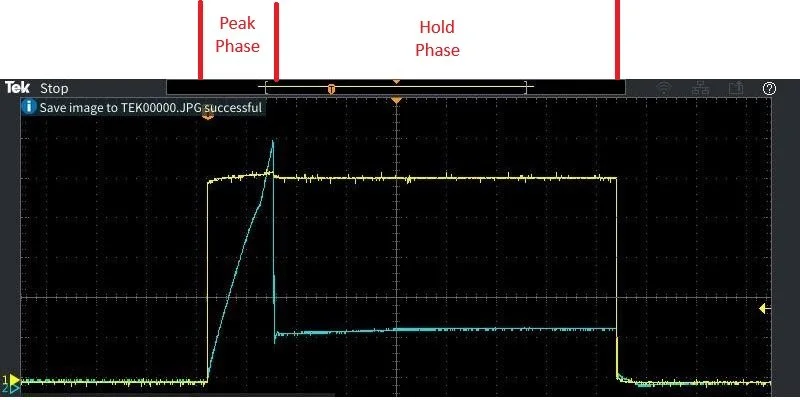
Note that if the new aftermarket injectors require less drive current than the factory injectors, you can install a properly rated resistor in parallel to each injector to "trick" the injector driver into thinking they are drawing more current than they are. Also, even if your replacement injectors had identical flow rate and impedance (i.e. Resistance and Inductance), this does not necessarily mean they are direct-fit replacements. For example, the 944 NA and 944 Turbo injectors have very different characteristics, but the NA and Turbo DME's injector driver is calibrated identical in terms of peak and hold current.
On a firmware level, the DME program must know a couple of things about the injectors. The main parameters are flowrate and deadtime. For flowrate, you must update this in the factory DME program. I have never actually done this, but from what I understand it is a bit convoluted. Perhaps someone with experience can chime in and provide a detailed process, ideally with a TunerPro/Ostrich setup. The deadtime must also be changed in the factory DME program, but this is not critical if it is not significantly different from factory injectors. Even if it was significantly different, if your engine is operating normally, the DME will use the NOB2 sensor to “trim” the fuel mixture and compensate. However, this closed-loop compensation is slow, and it must figure it back out on every significant load transition such as idle to acceleration. Because of this, it is better to just give the DME the updated deadtime values.
Hopefully this helps!
-Joe
